By Clarence, AI Media Marketing, Singapore
Watch a few AI video demos online and you could be forgiven for thinking the job is done in a minute. Upload a product photo, type a sentence, wait ten seconds, and out comes something that looks ready for a campaign. The demo always ends there, at the exciting part.
Try the same thing with a premium product, say a bespoke sapphire ring, a luxury watch or a leather bag with a signature clasp, and the illusion tends to break on the second or third clip. This piece explains why, what the work behind a premium AI film actually involves, and when a Singapore business can reasonably do it in house and when it is worth handing to a studio.
Key takeaways
- AI video tools are good at making a single clip look impressive. They are not built to keep one specific product identical across a whole film.
- On premium products, the usual failures are shape drift between angles, colour shift under moving light, and invented details such as extra fingers, melted logos or impossible watch hands.
- Most of the work in a premium AI film happens after generation: selecting takes, checking every shot against the real product, replacing logos, grading colour, sound and versioning. Our 21 second signet ring film needed around a dozen shots, each picked from many attempts.
- Do it yourself for mood boards, storyboards and quick social tests. Use a studio when the film carries your brand, shows the product up close or will be paid to reach customers.
Why the demos look so easy
Singapore businesses are trying AI quickly. IMDA’s Singapore Digital Economy Report found AI adoption among SMEs rose from 14.5 percent in 2024 to 23.4 percent in 2025. Plenty of those teams have opened a video tool, typed a prompt and been genuinely impressed by the first result.
That first result is impressive for a reason. A demo is judged on one clip, viewed once, usually of a generic object nobody is checking against the real thing. A product film is judged on many clips cut together, watched repeatedly, by customers who may have seen the actual piece in a boutique on Orchard Road. The bar is completely different.
The underlying reason is simple. A video model does not know what your product is. It does not understand how a watch movement drives the hands, how a gemstone is faceted, or how many knuckles a finger has. It predicts what each frame should look like based on everything it has seen before. Most of the time that prediction is close. Close is fine for a cat video. It is not fine for a S$30,000 ring.
Where a single prompt falls apart on premium products
The product changes when the camera moves
Film a handbag on a real turntable and the bag stays the same bag. An AI model redraws it in every frame and has no true sense of the object in three dimensions, so as the angle shifts, the product shifts with it. A clasp creeps sideways. A watch bezel thickens. Six prongs on a diamond become five, then a smooth rim. Viewers may not name what is wrong, but they feel that the object is not solid, and that feeling is fatal for a high ticket purchase.
Colour drifts with the light
In fine jewellery, colour is not a matter of taste, it is part of what a stone is worth. GRS, the Swiss gemmological laboratory, reserves its “pigeon’s blood” description for rubies with a vivid red colour free of brown and orange overtones, among other criteria. A red spinel can look very similar to the eye, but the description and the value are different. When virtual light sweeps across an AI scene, that ruby can drift towards orange, an emerald can wash out to mint and rose gold can turn brassy. A prompt cannot fix this. It takes grading against a daylight reference of the real piece.
The model invents things
This is the failure that ends up as a joke on social media. A hand modelling a ring grows a sixth finger or two knuckles merge. A logo dissolves into scribbles. A watch shows its hands pointing three ways at once, or the seconds hand runs backwards. In the background, a passer by gains an extra ear. Each of these can appear in a clip that otherwise looks stunning, which is exactly why they slip through when nobody is checking frame by frame.
We cover how to prevent each of these in detail in our guide to keeping your product exact in every AI shot, including a six point checklist you can use to review any AI film before it goes live.
What the hours actually go into
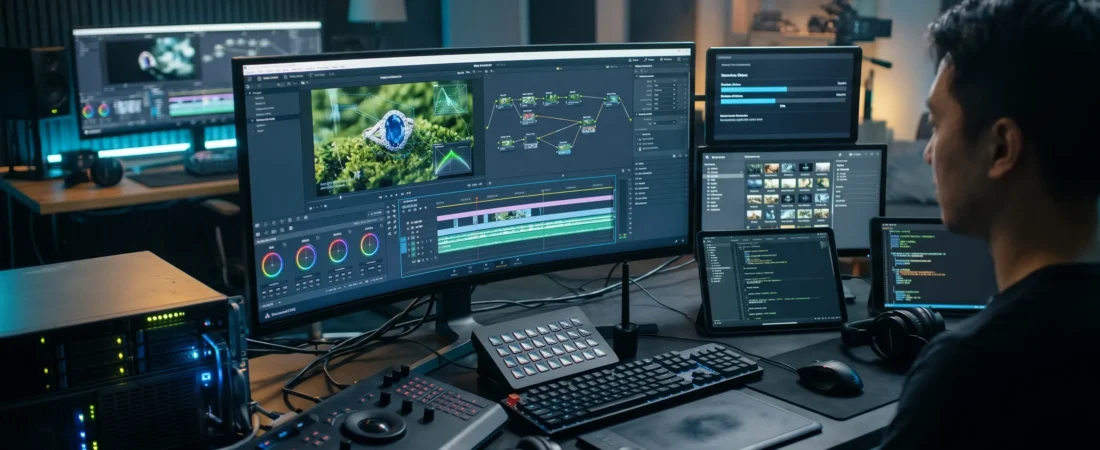
If the prompt is not where the work is, where is it? For a typical premium product film, our time goes roughly like this:
- Brief and reference. Photographs of the real product from every side, macro shots of the details that matter, colour references and a short list of things that must never change.
- Look development. Building approved still frames for each shot, with the product correct, before anything moves.
- Generation and selection. Animating each shot from its approved still and generating many takes. Most are rejected. Our signet ring craft film runs 21 seconds and needed around a dozen shots, each chosen from a stack of attempts.
- Shot by shot checking. Comparing every kept shot against the reference photos for shape, colour, detail count, text and anatomy. Anything that fails goes back a step.
- Clean up and compositing. Replacing generated lettering with your real logo artwork and fixing small artefacts.
- Edit, grade and sound. Cutting for rhythm, bringing product colour back to true, and adding sound design or music.
- Versions and search. Exporting for 9:16, 1:1 and 16:9, and writing titles, descriptions and video markup so the film can be found on Google and YouTube.
Generation itself is often the smallest slice of the schedule. The rest is judgement, and judgement is what you are paying for.
Doing it yourself or using a studio
| Use case | DIY with an AI video tool | Premium AI video studio |
|---|---|---|
| Mood boards and storyboards | A good fit | Not needed |
| Internal pitches and concept tests | A good fit | Optional |
| Quick organic social posts without close product shots | Often fine | Optional |
| Hero films, launch films and paid ads | Risky | Recommended |
| Close ups of jewellery, watches, cosmetics or labels | Hard to get right | Recommended |
| Films with hands wearing or using the product | Hard to get right | Recommended |
A sensible split for many Singapore brands is to explore ideas in house, then bring the strongest one to a studio to make properly. You arrive with a clearer brief, and the studio spends its time on craft rather than discovery.
Two Singapore rules worth knowing before you generate anything
Real people are personal data. Under the PDPC’s advisory guidelines, an image of an identifiable individual in a photo or video is personal data, and using it for publicity generally needs that person’s consent. That applies when you upload a staff member’s or customer’s photo to an AI tool to put them in an ad, not only when you film them.
Be open about what is generated. Singapore’s Model AI Governance Framework for Generative AI, published by IMDA and the AI Verify Foundation, encourages content provenance such as labelling and watermarking so people can tell what was made with AI. Meta, TikTok and YouTube now label or ask for disclosure of realistic AI content too. And whatever you disclose, the Singapore Code of Advertising Practice still expects the product to be shown truthfully.
Questions Singapore brands ask us
Can I make a premium product video with an AI tool myself?
You can make a usable draft, and for mood boards or quick tests that is often enough. For a film that shows your product up close, carries your brand or runs as a paid ad, expect to spend many hours selecting, checking and correcting, or hand it to a studio.
Why does AI change my product between shots?
Video models redraw every frame from patterns they have learned rather than from a 3D model of your product, so shape, colour and fine detail drift as the camera or light moves. Starting each shot from an approved still and checking every shot against the real product keeps it under control.
How long does a premium AI product film take?
Usually days to a few weeks rather than the two to three months of a traditional shoot, depending on length and complexity. Our comparison of AI video and traditional video production in Singapore covers timelines and costs in more detail.
Do I need consent to put a real person in an AI video?
Generally yes. The PDPC treats an image of an identifiable individual as personal data, and using it for publicity normally requires their consent.
AI lets us build places and moments around your product that would be impossible or very expensive to film. It is still a tool, and a premium film still needs someone who knows the product, directs the shots and refuses to let a sixth finger through. If that is the kind of film you need, tell us about your product.
About the author
Clarence leads AI Media Marketing, an AI video production studio in Singapore for premium products. He comes from Singapore’s fine jewellery trade, where he sources coloured gemstones and runs search and content for a bespoke jeweller. That is where the studio’s habit of checking every shot against the real product comes from: in jewellery, a stone that shifts half a shade on screen is a stone the client will not recognise across the counter.
Sources
- BritCham Singapore: AI adoption among businesses in Singapore rises (IMDA Singapore Digital Economy Report)
- GRS GemResearch Swisslab: GRS-type “Pigeon’s Blood” ruby
- PDPC: Advisory Guidelines on the PDPA for Selected Topics (photography)
- IMDA and AI Verify Foundation: Model AI Governance Framework for Generative AI
- Advertising Standards Authority of Singapore